What is VO₂ Max?
VO₂ max is the ultimate measure of your cardiorespiratory fitness. Simply put, your VO₂ max score indicates the maximum amount of oxygen your body can take in, transport, and utilise during exercise.
A good analogy for VO₂ max is your body’s engine size.
It isn't just a metric for elite marathoners or triathletes. It is the combined operational capacity of three vital systems working together:
- Your Lungs: Inhaling and transferring oxygen into the bloodstream.
- Your Heart & Blood Vessels: Pumping oxygen-rich blood efficiently to active tissues.
- Your Muscles: Extracting and utilising that oxygen to produce energy.
If any link in this chain degrades, your engine size shrinks and your VO₂ max drops.
Technically, VO₂ max represents the maximum volume of oxygen (in millilitres) your body can consume and utilise per kilogram of body weight per minute (mL/kg/min).
Why VO₂ Max Matters:
Because it measures your entire body’s systemic health, it is a staggering indicator of life expectancy.
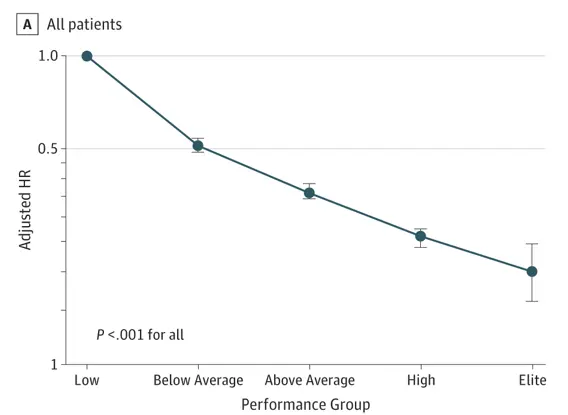
A 2018 study of 122,000 people over 8 years showed that your cardiorespiratory fitness is more predictive of how long you will live than traditional risk factors like smoking, high blood pressure, high cholesterol, and type 2 diabetes. View study
This study revealed that people in the lowest fitness group had roughly a fivefold higher risk of death compared to those in the elite fitness group.
The most interesting part of all was that the study showed no observable upper limit. The greater the cardiorespiratory fitness the lower the risk.
Every 1-MET increase in fitness (equivalent to a 3.5 ml/kg/min bump in VO₂ max) reduces all-cause mortality risk by roughly 13–15%, with no clear upper limit.
What a "Good" VO₂ Max Looks Like
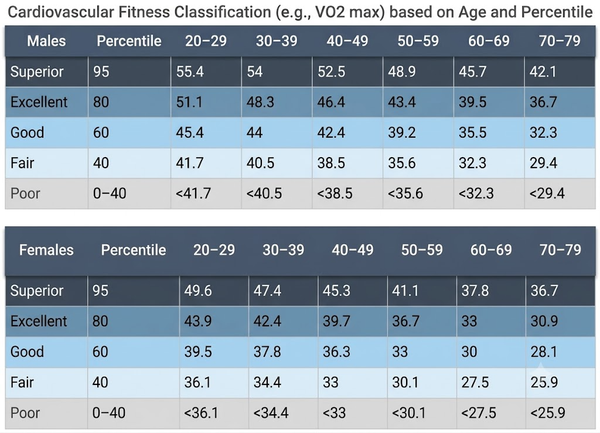
VO₂ max varies by age and sex, and it declines naturally as you get older (roughly 1% per year after your 30s if you do nothing about it).
Note on Testing: You don't need an expensive lab test to start improving. While modern smartwatches (Garmin, Apple Watch, WHOOP) estimate VO₂ max within a 10–15% margin of error, the exact number matters far less than the direction it is moving. Moving up just one fitness tier yields substantial health benefits.
However since people love to know… here is a graph from Garmin of VO₂ max categories by age and sex.
How to Actually Train Your VO₂ Max
Easy, conversational-pace training builds the aerobic base; more capillaries, more mitochondria, a stronger and more efficient heart. This is the bulk of what any good endurance program should be built on, and it's the foundation that makes everything else work.
HIIT Training (High Intensity Interval Training) 1-2 times per week is what really blows up your VO₂ max, the main idea is that we want to accumulate time near our maximal rate of oxygen consumption, forcing our heart to pump near its physiological limit. This can be accomplished by:
Protocol A: Long Aerobic Intervals (e.g., Norwegian 4x4)
- Work: 3 to 4 minutes at 85–95% max heart rate (a 9/10 effort).
- Rest: 2 to 3 minutes of active recovery (light walking/pedalling).
- Reps: Repeat 3 to 4 times
Protocol B: Short High-Frequency Intervals
- Work: 30 to 60 seconds of hard effort.
- Rest: Equal rest (30 to 60 seconds).
- Reps: Repeat 10 to 15 times.
The Takeaway
VO₂ max isn't a vanity metric for triathletes and marathoners. It's arguably the single most important number for how long you'll be around and how well you'll function while you're here.
The good news? It is highly trainable at any age. By pairing steady Zone 2 cardio with 1–2 high-intensity interval sessions each week, you can upgrade your engine, elevate your fitness, and add healthy, happy years to your life.